Visuals
Here you can find some key figures and visuals created by the COMPASS team. Please cite accordingly upon use. Thank you!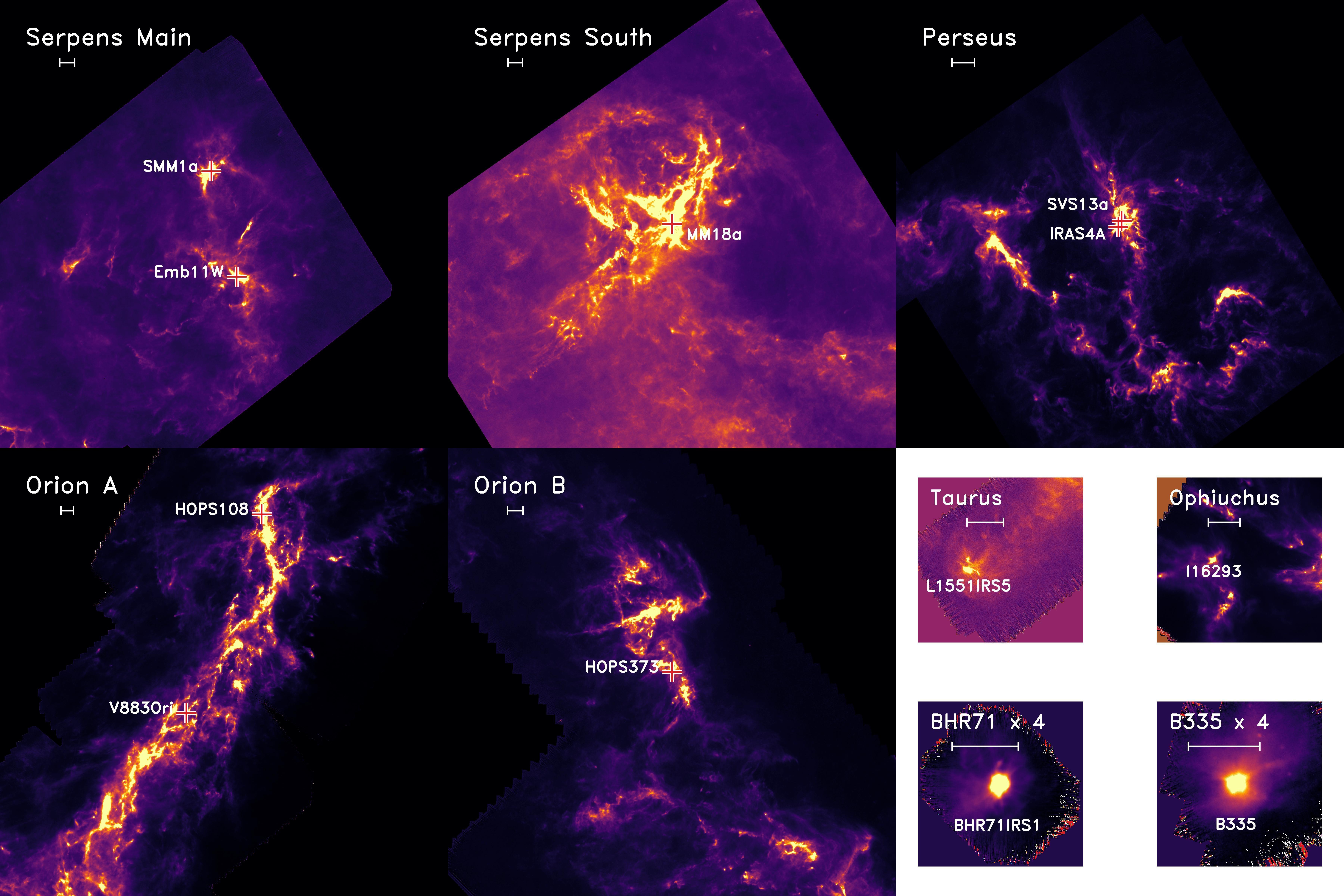
COMPASS surveys 11 protostars from
diverse star-forming environment here illustrated by
showing their locations compared to larger scale
maps of the dust column density traced by Herschel (Jørgensen et al. 2026).
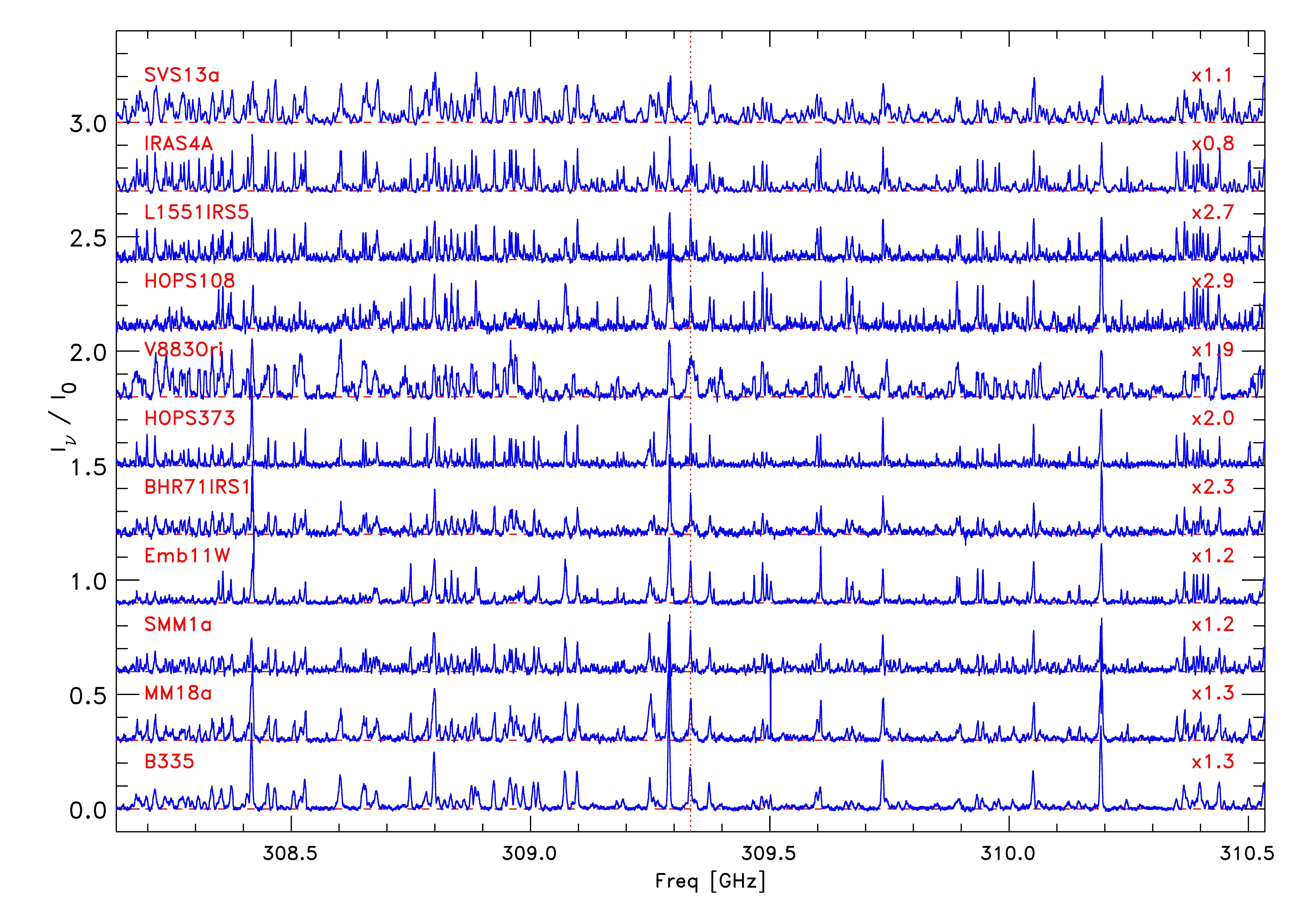
Comparison of example spectra from
the COMPASS observations of the 11 protostellar sources (Jørgensen et al. 2026).
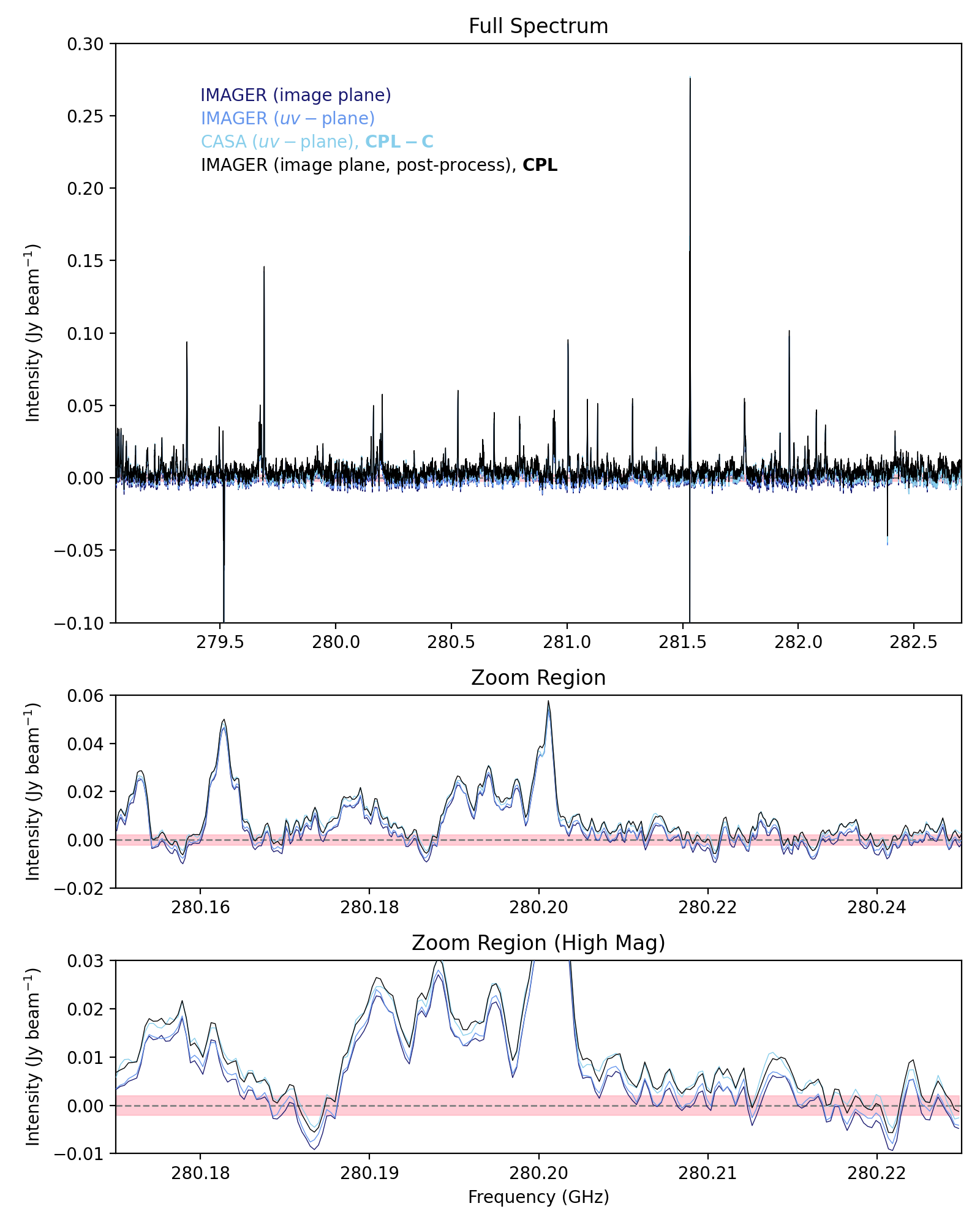
The COMPASS data reduction procedure involved inspecting various methods of imaging -- by CASA and IMAGER software - and continuum subtraction - in the uv- or image-plane, or via post-processing - following by careful inspection of the slight variations in different frequency ranges, as we show here for one frequency tuning towards the source BHR71-IRS. (Plunkett et al. 2026).
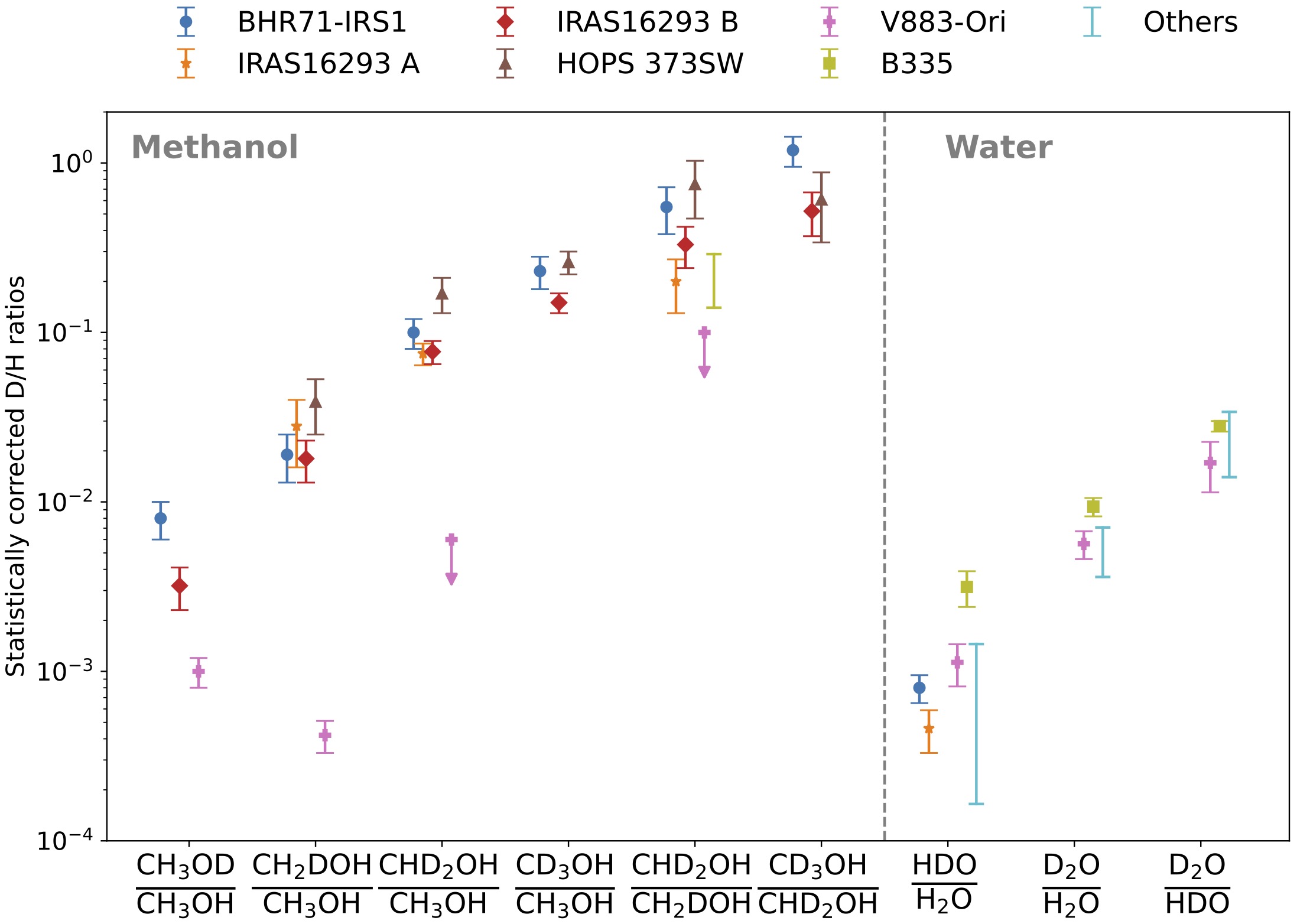
Comparison of the statistically
corrected D/H ratios of methanol, CH3OH measured in low-mass
protostars with ALMA observations (Coutens et al. 2026).
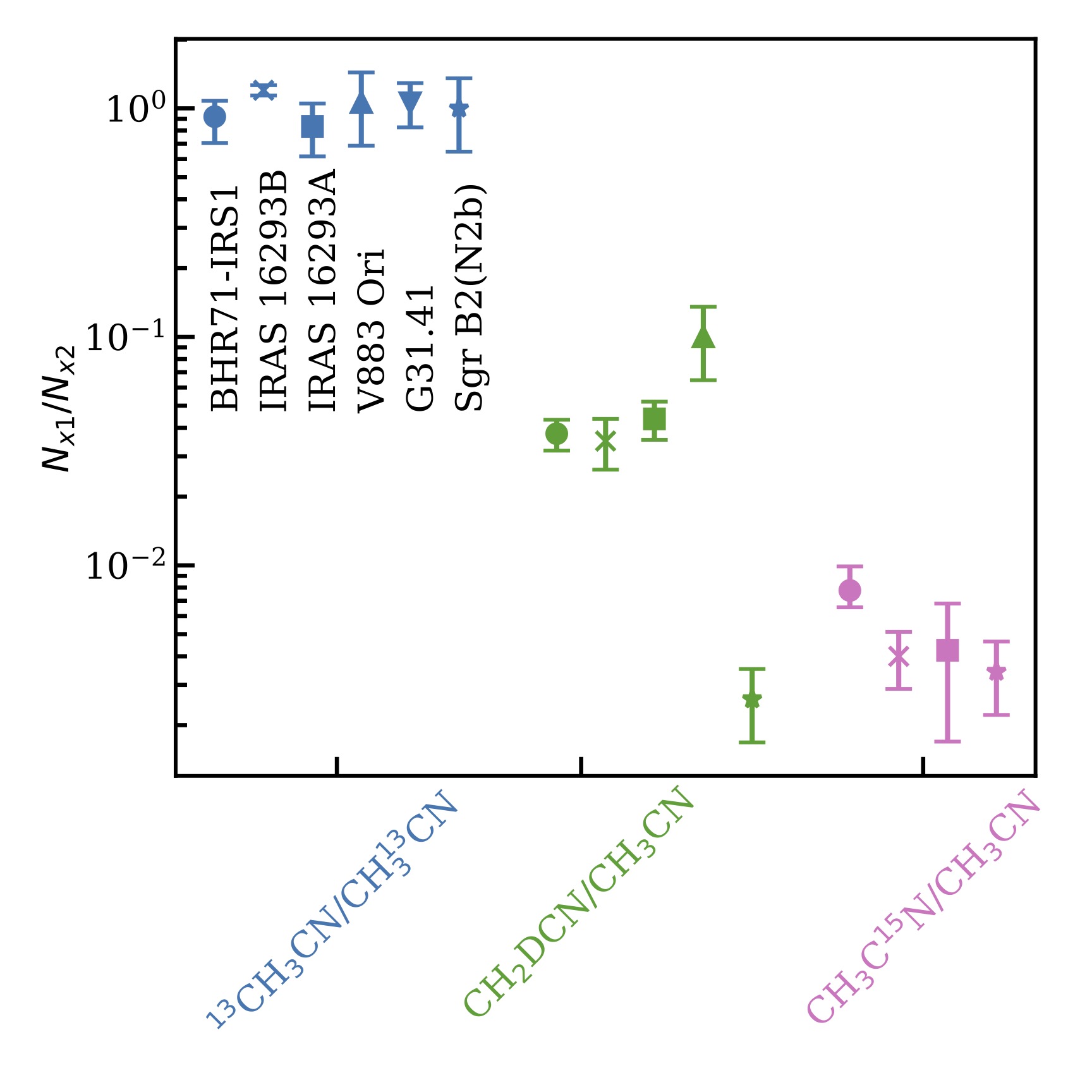
Column density ratios of various
methyl cyanide, CH3CN isotopologues for different protostellar systems. The 13CH3CN/CH313CN ratio is remarkably constant and consistent with unity. This points to the similar probability of 13C getting incorporated in the CH3 or CN group. (Nazari et al. 2026).
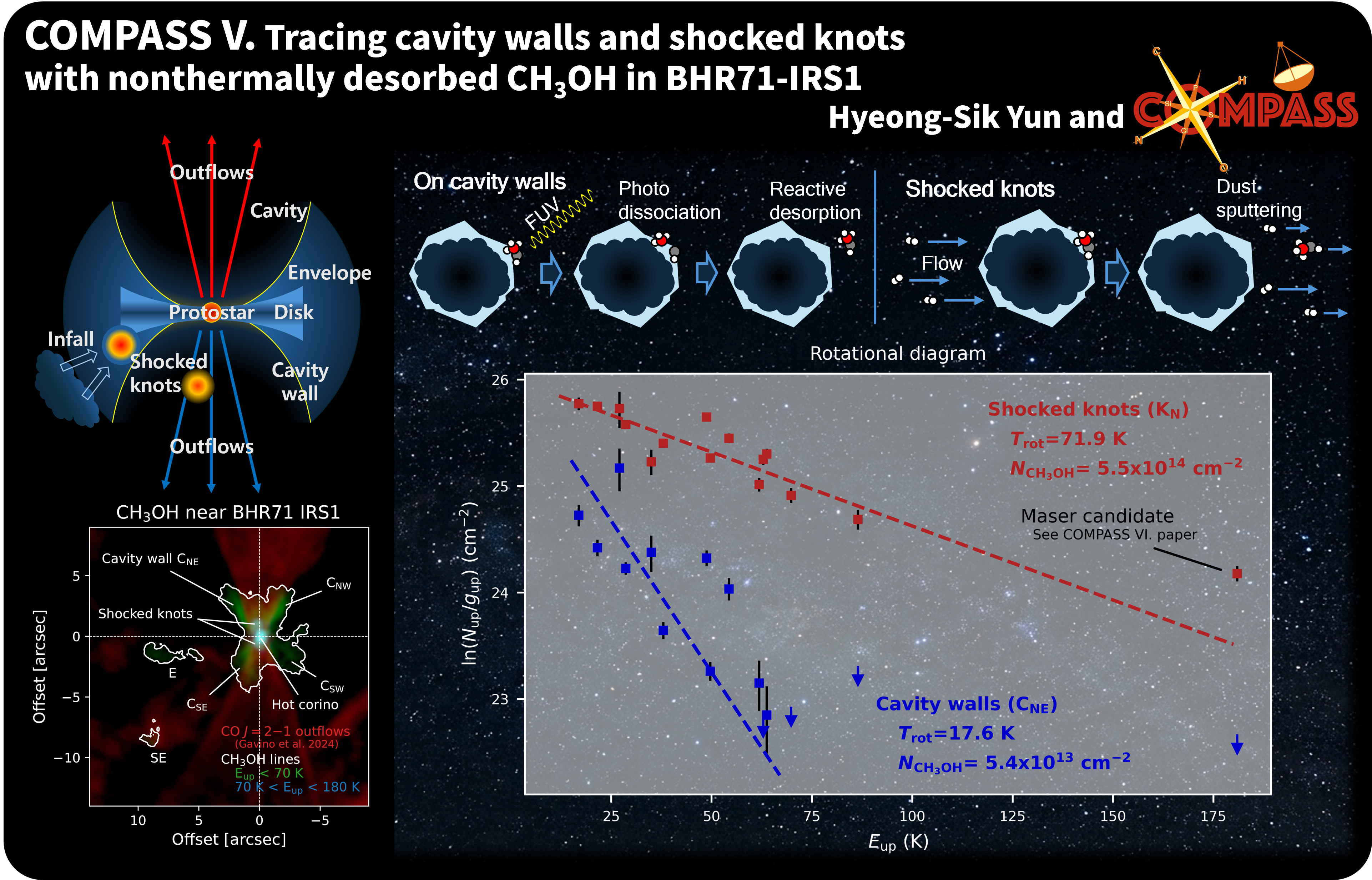
Weak extended methanol emission is
found in the vicinity of the isolated young protostar,
BHR71-IRS1. Detailed LTE analysis (rotational diagram
and spectral model fitting) suggests that the methanol
molecules are released into the gas phase through non-thermal desorption. The most likely mechanisms are reactive desorption on the cavity walls and dust sputtering in the shocked knots. (Yun et al. 2026).
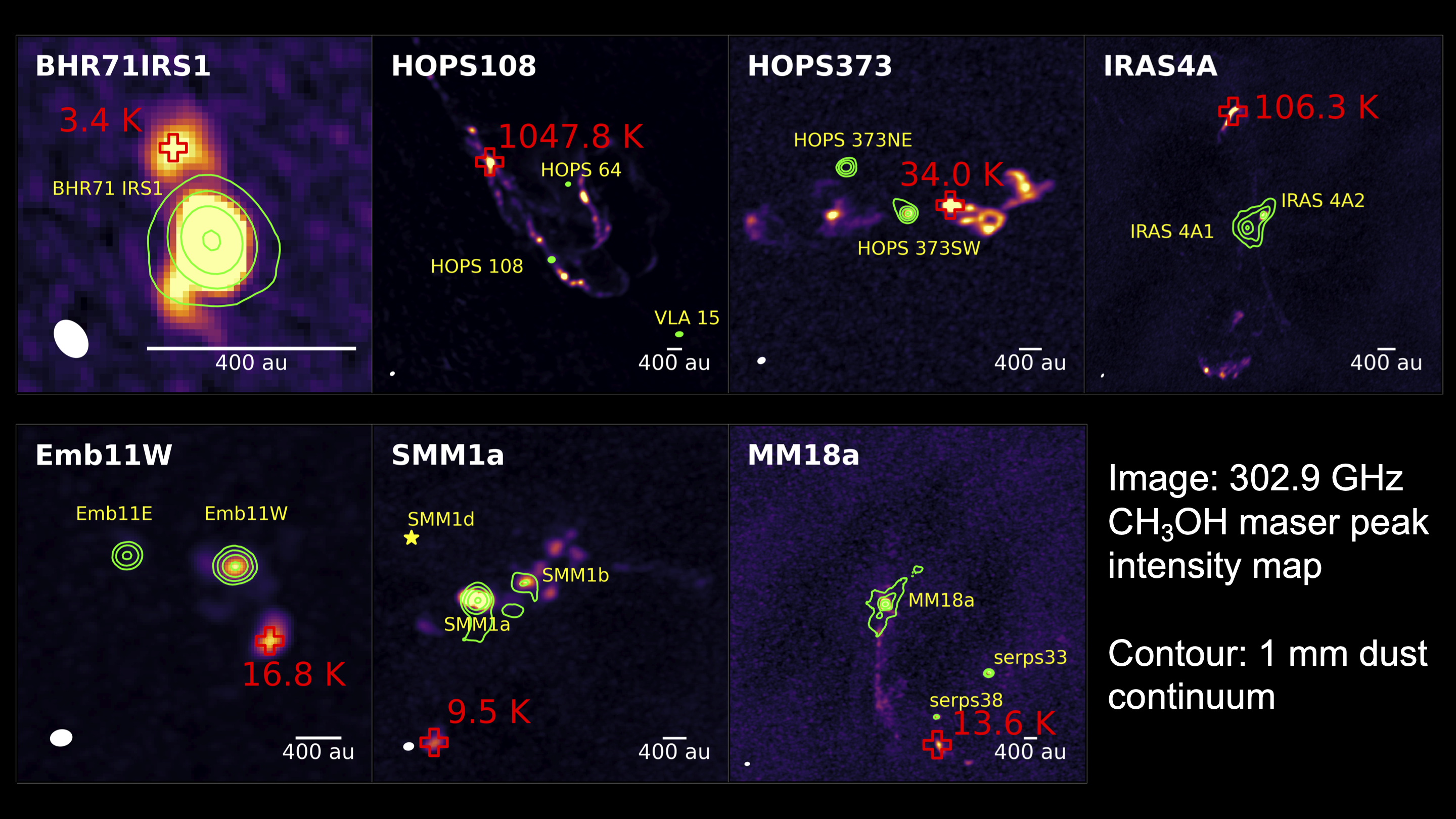
Peak intensity maps of the newly and serendipitously discovered 302.9 GHz class I methanol maser in the COMPASS ALMA spectral survey. The maser is detected toward seven of the eleven COMPASS targets, representing a substantially higher detection rate than previously reported for low-mass protostars. The red crosses mark the positions of the brightest maser emission, and the red numbers indicate the maser brightness temperatures at these positions. The maser emission is primarily associated with protostellar outflow cavity walls and bow shocks. Emission coincident with the continuum sources arises from the same 302.9 GHz transition but is thermal rather than masing. (Jeong et al. 2026).
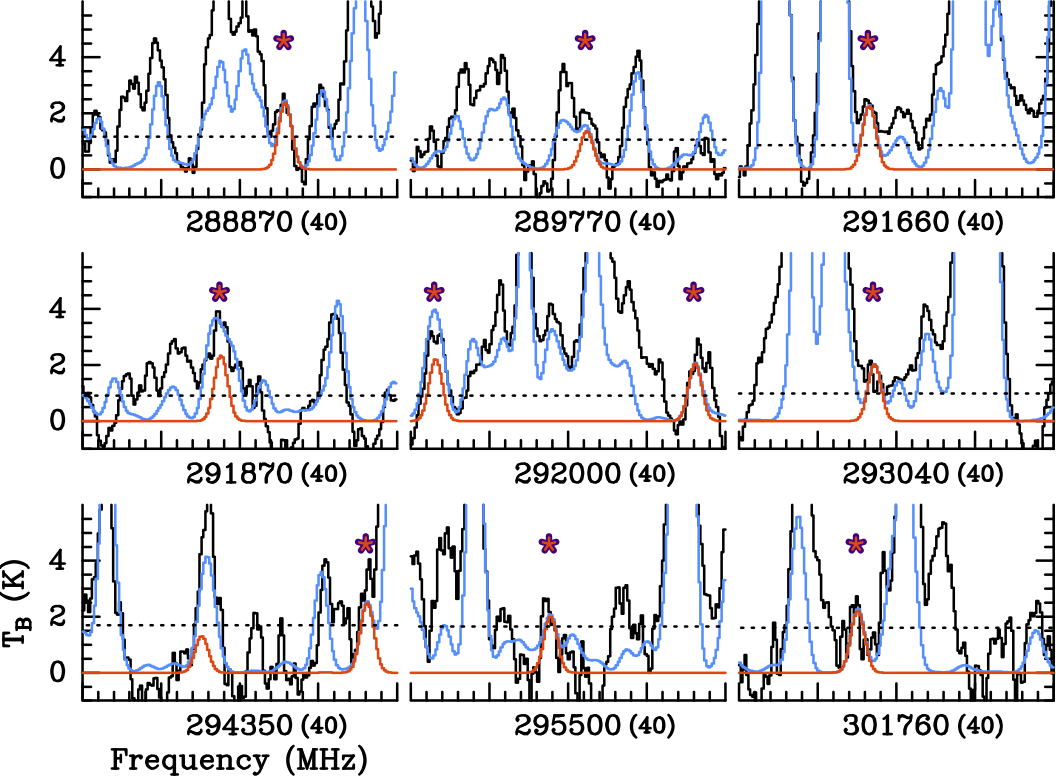
The figure presents the first interstellar detection of fully deuterated methanol, CD3OD, toward the young protostar NGC1333 IRAS4A2. The sensitive COMPASS observations reveal that the apparent D/H ratio of methanol increases from the singly to multiply deuterated isotopologs, a pattern that is quantitatively not reproduced by current chemical models of prestellar and protostellar cores. (Belloche et al. 2026).

COMPASS logo: png for light background (created by Mihika Rao)

COMPASS logo: png for dark background (created by Mihika Rao)